


On October 16, 2026, Peru’s production ministry closed the second anchoveta season outright: juvenile fish made up 79% of the catch by number and 65% by weight, and anchoveta condition was too poor to process, with oil content under 1%. The global fish meal index published by the IMF (World Bank pinkfish series) has since reached USD 2,950.79 per metric ton for September 2026, against USD 1,559.30 in September 2025 — an 89% year-on-year move. Over the same window, soybean meal futures sat in a USD 275–325 per short ton range for 2026.
Put those two numbers side by side and you get the story of this feed season: fish meal now costs about 8.8 times soybean meal, versus roughly 3.6 times in 2024. For a feed formulator, that changes the maths; for a fish meal plant owner, it changes the price you can sell at — and for how long. The rest of this article puts all three proteins on one price sheet, converts them to cost per unit of protein, and shows where the substitution actually stops working.
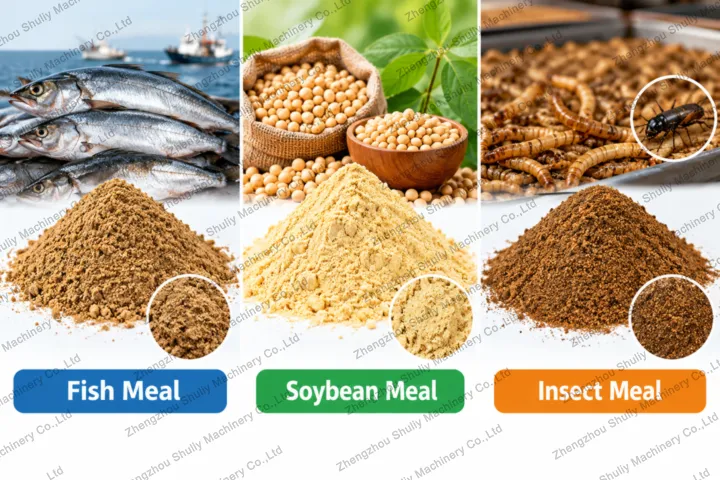
Key points at a glance
- Fish meal is at a record high, not just a seasonal high. USD 2,950.79/t (September 2026 index) against a 2024 average of USD 1,434.91/t — more than double two years ago.
- Soybean meal is not following it up. A record 2026/27 global soybean crop and expanding crush keep meal in the USD 275–325/short ton band, so the gap is being caused by the fish side, not the soy side.
- Insect meal sits in the middle, and moves with fish meal. Dried black soldier fly larvae in China trade around CNY 8,500/t (≈USD 1,200/t), roughly 40% below current fish meal per tonne — but volumes are thin and grades are inconsistent.
- The formulation lever is not protein price; it is the non-protein value of fish meal. Palatability, amino acid profile, phosphorus and the residual oil are what buyers are actually paying for.
The 2026 price sheet: three proteins, one table
| Ingredient / grade | Quoted price | USD per metric ton | โปรตีนหยาบ | USD per tonne of protein |
|---|---|---|---|---|
| Fish meal — global index (pinkfish) | USD 2,950.79/t (Sep 2026) | 2,951 | ~65–68% | 4,339–4,540 |
| Fish meal — Peru super steam dried, China landed | CNY 24,800–25,000/t (Oct 20, 2026) | ≈3,507 | ~68–70% | ≈5,010 |
| Fish meal — China domestic | CNY 18,500–19,000/t | ≈2,641 | ~60–65% | ≈4,200 |
| Soybean meal — 2026 projected band | USD 275–325/short ton | 303–358 | 44–47% | 687–791 |
| Insect meal — BSF larvae, dried (China listing) | CNY 8,500/t | ≈1,197 | 45–55% | 2,394 |
| Insect meal — dried mealworm (China retail lots) | CNY 10,000–30,000/t | ≈1,400–4,200 | 50–60% | 2,333–7,000 |
Caption: Fish meal index: IMF / World Bank pinkfish series via FRED (PFISHUSDM), monthly USD per metric ton. Soybean meal: FarmDoc daily, February 2026, USD per short ton; metric conversions at 0.907 t per short ton. China landed and insect quotes are Chinese market daily reports and B2B listings, converted at CNY 7.1 per USD. Protein contents are typical commercial values, not lab results.
Read the last column, not the second one. On a cost per tonne of crude protein basis, soybean meal is roughly six times cheaper than fish meal right now, and dried insect larvae land in between at about half the fish meal figure. That single column explains every substitution decision feed mills are making this quarter.
How far the ratio has moved
| Period | Fish meal (USD/t) | Soybean meal (USD/t) | Ratio |
|---|---|---|---|
| 2024 average | 1,434.91 | 397 (long-run average basis) | 3.6 |
| 2025 average | 1,510.75 | 397 | 3.8 |
| September 2026 | 2,950.79 | 337 | 8.8 |
| September 2026, constant soy basis | 2,950.79 | 397 | 7.4 |
Caption: The 2026 row mixes a current soybean meal contract with a long-run average in the earlier rows, so we also show the ratio recalculated against the same USD 397/t soy basis. Either way the spread has roughly doubled.
Historically, a ratio of 2.5–3.5 is the zone where keeping fish meal in marine and starter diets is easy to justify. Above about 6, formulators stop asking whether to reduce inclusion and start asking what to replace it with. We are now at 7.4–8.8, which is why the search for fish meal substitutes has jumped this year — and why the three articles on this site that previously explained fish meal’s nutritional value with no numbers now have a live market to talk about.
The formulation maths: what the ratio actually changes
Take a tonne of feed formulated with 5% fish meal at 68% protein. That is 50 kg of fish meal delivering 34 kg of crude protein, and at USD 2,950/t it costs USD 147.50 per tonne of feed. Matching those same 34 kg of protein with soybean meal at USD 337/t takes about 74 kg of meal and costs USD 24.90. On paper, the substitution is worth roughly USD 122 per tonne of complete feed — over 4,000 t of annual output that is close to half a million dollars.
No formulator takes all of it, and that is the important part. The reason is that fish meal is not bought only for protein
- Amino acid balance and digestibility. Fish meal carries a complete, highly available profile; soybean meal is short on methionine and needs crystalline amino acids and enzymes added back, which consumes part of the savings.
- Palatability and intake. The attractant effect of fish solubles is the main reason marine and starter diets keep some fish meal in even at USD 2,950/t. Our breakdown of the seven components of fish meal covers which fractions do this work.
- Functional nutrients. Choline, inositol, vitamin B12, selenium and the long-chain fatty acids in residual fish oil are not in the soya complex.
- Inclusion ceilings, not price, set the limit. In carnivorous aquaculture diets, soya is capped by anti-nutritional factors and gut health, not by the price ratio — see which feed is best for fish.
The practical result this season: inclusion rates come down in grow-out and poultry diets first, and hold in starter, weaner and broodstock diets last. The demand curve does not vanish — it just concentrates into the grades with the highest protein and lowest bacteria counts, which is exactly where Peruvian super and Japan-grade meal sit.
Where insect meal really stands in 2026
Insect meal is the ingredient everyone quotes and nobody can source at scale. On the Chinese exchange, dried black soldier fly larvae have been listed around CNY 8,500/t (≈USD 1,200/t), with fresh and frozen larvae at CNY 2,200–3,100/t on an as-fed basis. Dried mealworm trades far higher, CNY 10,000–30,000/t, mostly in small pet-food and poultry lots rather than mill volumes.
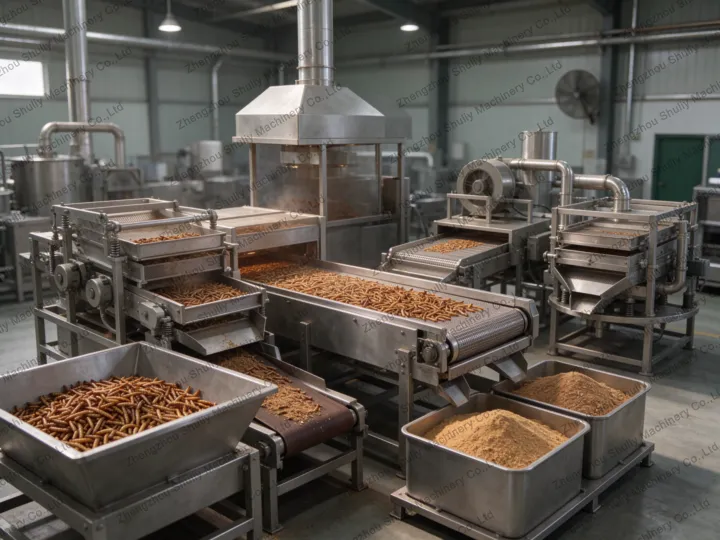
Three honest limits on the insect option
- Volume. Global insect meal output is a fraction of fish meal trade, so it cannot arbitrage an 8.8 ratio away. It absorbs marginal demand, it does not replace a Peruvian season.
- Fatty acid profile. BSF larvae fat is dominated by lauric acid, which transfers into the farmed fish tissue and changes the product’s fatty acid signature — a real constraint in aquaculture, and a reason the residual fish oil fraction stays valuable.
- Rules differ by market. Approvals for insect protein have widened step by step in the EU and elsewhere, species by species, and remain restricted in ruminant feed. Confirm the current text applying in your destination market before formulating for export.
For operators wanting to enter that segment with equipment they already understand, our เครื่องแยกหนอนอาหาร handles larvae-to-bran-and-frass separation, and this Australian customer case shows a working farm-scale setup.
The middle tier nobody advertises: feather meal, MBM and poultry meal
Between soya and fish meal sits the group that actually absorbs substitution demand in high-ratio years. Poultry meal has been benchmarked in the USD 700–800/short ton range in recent Fastmarkets reporting; hydrolyzed feather meal runs above 80% protein, and meat-and-bone meal supplies the calcium and phosphorus that soya cannot. Their shortage risk is different from fish meal’s: it depends on your rendering and hydrolysis capacity, not on an El Niño index.
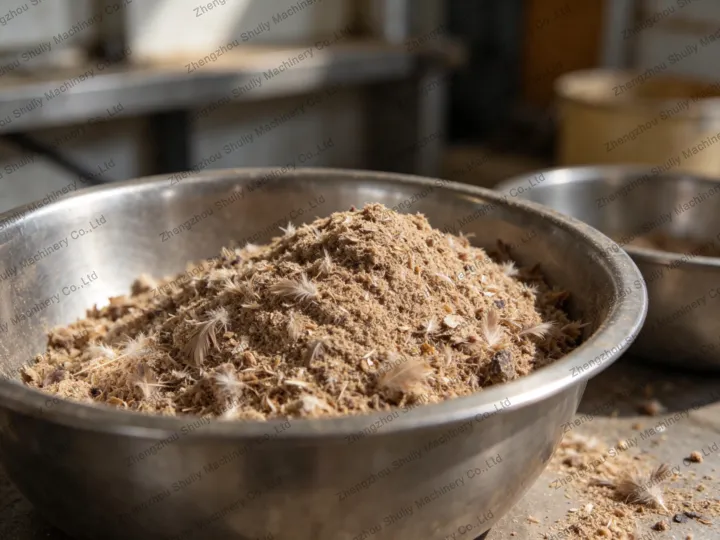
See our สายการผลิตอาหารเป็ดขน, the hydrolysis process explained, and how MBM is made. For fish processors specifically, a defatted fish meal line turns the same raw material into a higher-protein, lower-fat grade that holds its price better when standard meal is being substituted out.
What a high ratio means for a fish meal plant operator
This is the flip side of the same market. Every tonne you produce sells far above the two-year average, but the buyers who take the most tonnage — broiler and pig mills — are the ones walking away first. Two consequences matter
- Quality grading pays unusually well this year. When the protein-price gap widens, the surviving demand concentrates on 65%+ protein, low-volatility meal. Cooking and drying control are worth more than throughput: see เครื่องอัดสกรู and fish oil separator configuration for holding both protein and oil.
- Raw material cost, not selling price, decides your margin. Small and compact plants that sit next to a reliable waste or bycatch stream survive the squeeze better than large plants bidding against soya economics. Our production cost breakdown and ROI and payback analysis use plant-level figures rather than averages.
What to watch next
- The next Peruvian season declaration and whether the juvenile-stock problem repeats — that, not soya, is what sets the ceiling on this ratio.
- Chinese port inventories and domestic meal output, since domestic at CNY 18,500–19,000/t is now the marginal price that limits how far imported super-grade can run.
- Soyo weakness. A record 2026/27 global crop and expanding crush keep soybean meal soft, which pushes the ratio wider rather than narrower and accelerates substitution.
- Fish oil. The same closure that lifted meal also tightens oil; if you sell meal but buy nothing, that is the line item to watch. Context for the supply shock is in our report on the 2026 El Niño halt to the anchoveta season.
Frequently Asked Questions
How much does fish meal cost compared with soybean meal in 2026?
The global fish meal index reached USD 2,950.79 per metric ton in September 2026, while soybean meal for 2026 was projected in the USD 275-325 per short ton range (about USD 303-358 per metric ton). That is a ratio of roughly 8.8, compared with about 3.6 in 2024. On a constant soybean meal basis, the 2026 ratio is about 7.4.
Can soybean meal simply replace fish meal in feed?
Not one for one. Fifty kilograms of fish meal at 68% protein delivers about 34 kg of crude protein for USD 147.50 per tonne of feed; matching that protein with soybean meal takes about 74 kg and costs USD 24.90. The gap closes on protein price alone, but soybean meal lacks the amino acid balance, palatability, choline, vitamin B12, selenium and residual fish oil that make fish meal valuable, and it carries inclusion limits from anti-nutritional factors in carnivorous species.
Is insect meal cheaper than fish meal?
Per tonne, it usually is, but it is not cheap on protein. Dried black soldier fly larvae have been listed in China around CNY 8,500 per tonne (about USD 1,200), which works out to roughly USD 2,400 per tonne of crude protein against about USD 4,300 for fish meal. Dried mealworm trades much higher, CNY 10,000-30,000 per tonne, mostly in small lots. The binding constraint is supply volume and grade consistency, not price.
Which protein substitutes for fish meal fastest when prices spike?
The first reductions happen in grow-out and poultry diets, where soya, corn distillers grains, poultry meal and hydrolyzed feather meal can absorb the volume. Starter, weaner and broodstock diets hold fish meal longest because palatability and functional nutrients matter more there. Feather meal, MBM and poultry meal form the practical middle tier because their supply depends on rendering capacity rather than fishing seasons.
Does a high fish meal price make fish meal plants more profitable?
Only if raw material cost stays under control. High selling prices reward plants that own or have long-term access to their fish or bycatch supply, and squeeze plants that must bid for raw fish in a short season. The deciding variables are protein recovery, energy cost per ton and the grade your line can consistently reach.
If you are sizing a plant for this market — whether the goal is higher-grade fish meal that holds its price under substitution pressure, or a feather meal and MBM line to serve the middle tier — send us your raw material, target protein grade and daily tonnage and we will price the configuration against these 2026 numbers.