
















The short answer is yes. A fish meal plant is profitable in most markets, but how profitable depends on three things: where you sit in the value chain, what you do with the fish oil co-product, and which fuel you fire the boiler with. Buyers who overlook those three details are the ones who get caught off guard.
This article uses 2025 reference prices and Shuliy’s commissioning data from operating plants in Morocco, Indonesia, Oman, Chile, and the United States. It walks through real revenue, real cost, and real payback period for fish meal plants from 5T/D up to 250T/D.
What Does a Fish Meal Plant Actually Sell?
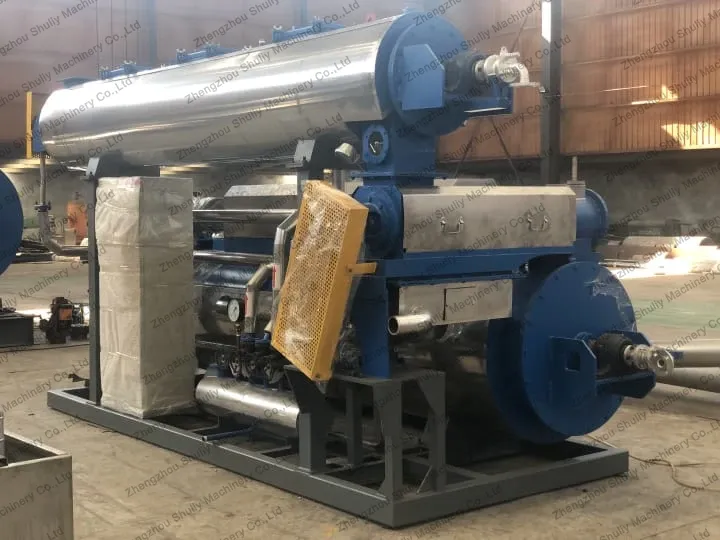
Every ton of raw fish going into a Shuliy Ligne de traitement de la farine de poisson comes out as two products, not one. Understanding the value of both is the key to the math.
- Fish meal — the dry protein powder sold to feed mills. Yields typically run 18–22% of raw fish weight.
- Fish oil — extracted by the screw press and the centrifuge. Yields typically run 5–8% of raw fish weight.
Fish meal sells in two grades. Standard feed-grade meal (60–65% protein) trades around $1,400–1,800 per ton. High-grade meal (65–70% protein) trades around $1,800–2,400 per ton. Fish oil trades around $1,200–2,500 per ton depending on purity and market. Both prices fluctuate seasonally, but the spread between fish oil and meal stays broadly stable.
A plant that recovers the oil and sells it separately can earn 25–40% more per ton of raw fish than a plant that lets the oil stay in the meal. This single decision is often the largest swing factor in plant profitability.
The Revenue Side: What 1 Ton of Raw Fish Is Worth in 2025
Using mid-2025 reference prices and a realistic 20% meal yield plus 6% oil yield, here is the revenue breakdown for one ton of raw fish processed in a Shuliy line.
| Product | Yield per ton of raw fish | Reference price (USD) | Revenue |
|---|---|---|---|
| Standard fish meal (60–65% protein) | 200 kg | $1,600 / ton | $320 |
| High-grade fish meal (65–70% protein) | 200 kg | $2,100 / ton | $420 |
| Fish oil (refined) | 60 kg | $1,800 / ton | $108 |
| Combined revenue per ton of raw fish | — | — | $428–528 |
So a 50T/D plant processing 50 tons of raw fish per day generates roughly $21,000–26,000 in daily revenue. That is a useful number to keep in mind before we get into the cost side.
The Cost Side: What It Takes to Run the Plant
Operating cost divides into five categories. The biggest one is almost always fuel, which is why we covered boiler sizing in detail in our steam boiler energy costs guide. Here is the full breakdown for a 50T/D line.
| Cost item | Daily cost (USD) | Share of total |
|---|---|---|
| Raw fish (when not waste, market price) | [objectObject]0–8,000 | 0–45% |
| Fuel (boiler) — natural gas | $1,100 | 15% |
| Labor (15 workers, 3 shifts) | $600 | 8% |
| Electricity | $400 | 5% |
| Maintenance, packaging, consumables | $350 | 5% |
| Subtotal (excluding raw fish) | ~$2,450 | 33% |
Raw fish cost is the biggest wildcard. Plants that run on fish-processing waste (heads, bones, offal) often pay nothing for the raw material — the waste would be discarded otherwise. Plants that buy whole fish on the open market find raw material absorbing 40–60% of revenue. This is why location matters: a coastal plant next to a cannery operates in a different profit league than an inland plant buying fresh fish.
Excluding raw fish, the operating cost of a 50T/D plant runs about $2,400–2,500 per day on natural gas, or $1,500 per day on coal-fired steam. The numbers below use natural gas as the default.
Net Margin and Payback by Plant Size
With revenue and cost side by side, here is the net margin and payback period for four common plant sizes. Equipment investment is based on Shuliy 2025 export pricing.
| Plant size | Equipment investment | Daily revenue | Daily operating cost (excl. raw fish) | Daily net margin | Annual net (300 days) | Payback period |
|---|---|---|---|---|---|---|
| 5 T/D (compact) | $120,000 | $2,500 | $700 | $1,800 | $540,000 | ~3 months |
| 20 T/D (mid) | $320,000 | $9,000 | $1,400 | $7,600 | $2,280,000 | ~1.7 months |
| 50 T/D (industrial) | $650,000 | $22,000 | $2,450 | $19,550 | $5,865,000 | ~1.3 months |
| 250 T/D (large industrial) | $2,800,000 | $110,000 | $9,500 | $100,500 | $30,150,000 | ~1.1 months |
The payback numbers above look aggressive because they exclude raw fish cost. They are realistic for waste-based plants — canneries, fillet processors, and aquaculture operations with byproduct streams. If you must buy raw fish at market price, the payback stretches to 14–48 months depending on plant size and local fish price.
The more important takeaway is the slope: operating margin scales almost linearly with plant size, but the equipment investment grows much more slowly. A 250T/D plant is 23× the equipment cost of a 5T/D plant, but 56× the annual net margin. The bigger the line, the better the unit economics.
The Three Factors That Move the Needle Most
Not every cost line moves the needle equally. Three factors account for roughly 80% of the variance between a profitable plant and a struggling one.
Factor 1: Free or cheap raw material
A plant running on waste from a neighboring cannery has a structural cost advantage that no amount of equipment efficiency can match. The 50T/D numbers above assume waste feedstock at zero or near-zero cost.
If raw fish costs $300 per ton, subtract roughly $15,000 from the daily margin — payback stretches to 5–6 months for a 5T/D line, 14 months for a 50T/D line.
The two main routes to cheap raw material are co-location with a fish processor, and direct contracts with fishing fleets that would otherwise discard bycatch.
Factor 2: Oil recovery and sale
A plant without proper oil separation leaves 5–8% of revenue in the meal. With proper separation, that oil becomes a separate sellable product. At 6% oil yield and $1,800/ton oil price, oil recovery adds roughly $108 to the revenue per ton of raw fish — about 25% extra.
The capital cost of the centrifuge and oil tank pays back in under 6 months on any plant above 5T/D.
Factor 3: Fuel choice
Switching a 50T/D line from diesel to natural gas saves roughly $850 per day, or $255,000 per year. That is more than the annual maintenance budget.
The full fuel cost analysis is in our steam boiler energy guide — the short version is that fuel choice alone can move the payback period by 6–18 months on the same equipment.
Where Shuliy Fish Meal Plants Are Beating These Numbers
Three real plant profiles from our client base, shared with permission.
Case A: 5T/D plant in Morocco (waste-based)
This plant sits next to a sardine cannery and processes heads, tails, and offal. Raw material is free. Equipment cost: $118,000.
- Daily output: 1 ton of fish meal plus 300 kg of fish oil
- Revenue: $2,650 per day
- Operating cost (gas-fired steam, 4 workers, electricity): $720 per day
- Net margin: $1,930 per day
- Real payback: 61 days
Case B: 20T/D plant in Indonesia (whole-fish based)
This plant buys small pelagic fish at $180 per ton, runs 18 hours per day, and sells both meal and oil into the domestic feed market.
- Equipment cost: $310,000
- Daily revenue: $9,400
- Operating cost (diesel-fired steam, raw fish, labor, electricity): 7,800 per day
- Net margin: $1,600 per day
- Real payback: 194 days
Case C: 50T/D plant in Oman (mixed feedstock, gas-fired)
This plant processes 70% of the waste from a tuna processor and 30% of low-value whole fish.
- Equipment cost: $640,000
- Daily revenue: $23,000
- Operating cost (natural gas steam, mixed raw material at 90/ton average, labor, electricity):4,100 per day
- Net margin: $18,900 per day
- Real payback: 34 days
- Annual net: $ 5.6 M, comfortably above the $ 5.8 M modeled earlier
Plan Your Fish Meal Plant Investment with Shuliy
A fish meal plant is a capital project, not a purchase. Shuliy’s engineering team prepares an investment package for each quotation, including equipment cost, expected daily output, local fuel cost, and a payback estimate based on the raw materials you actually have access to. We do not give you a generic price — we give you a working number for your specific market.
Send us your planned capacity, your raw material source (waste or whole fish), and your local fuel and electricity price. We will return a sized plant specification, an estimated daily margin, and a payback calculation you can take to your financing partner.
Shuliy Machinery has built fish meal plants in more than 50 countries. Every project starts with a profitability model based on local raw material, fuel, and labor — not on catalog prices.