















Energy is the single largest controllable operating cost in a fish meal plant. In most of the projects Shuliy commissions, the steam bill — not raw fish, not labor, not equipment depreciation — decides whether the line turns a profit by month’s end. Yet almost every buyer we meet asks about boiler price first and boiler sizing never.
That is a mistake. An undersized fish meal plant boiler chokes the dryer, slows production, and damages protein quality. An oversized boiler burns cash every hour it idles. This guide walks through how to size a boiler correctly, what steam each piece of equipment actually consumes, and how diesel, natural gas, coal, biomass, and electricity compare in real monthly cost.
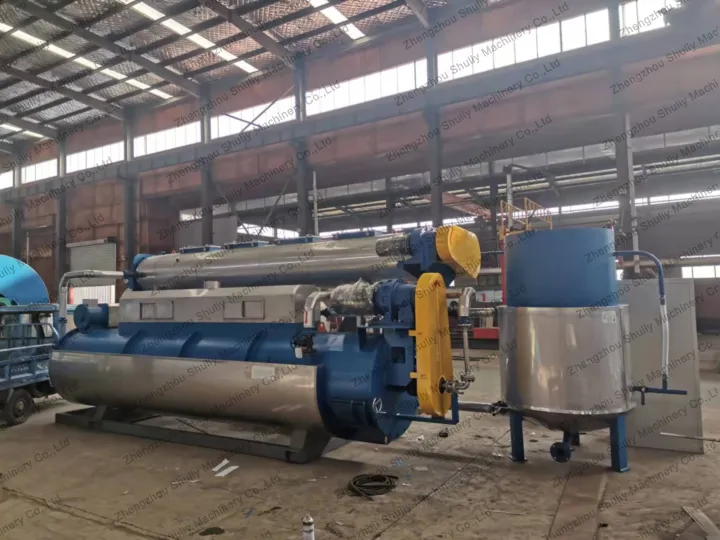
Why Energy Is the Largest Operating Cost in a Fish Meal Plant?
Walk into any operating fish meal plant and the same pattern shows up in the books. The cookers, dryers, and presses run day and night, but the boiler room runs longer. To turn wet fish (roughly 60–70% moisture) into dry meal (under 10% moisture), you must evaporate a lot of water — and water does not leave on its own.
Rough rule of thumb from our engineering team: for every 1 ton of finished fish meal, you need to evaporate roughly 4–5 tons of water. Each kilogram of water evaporated requires about 0.6–0.7 kg of steam at 0.6 MPa. So a 50T/D plant moves around 1.5 tons of steam per hour, and a 250T/D plant moves around 6–8 tons of steam per hour, around the clock.
At typical 2025 fuel prices, that translates into:
- 50T/D plant: ~700–2,200 per day in fuel, depending on source
- 100T/D plant: ~1,400–4,400 per day
- 250T/D plant: ~3,500–11,000 per day
Over a 300-day operating year, the difference between choosing natural gas and choosing diesel on a 100T/D plant can exceed $400,000. The fish meal plant boiler selection shapes the project budget — it does not sit beside it.
Where Steam Is Actually Used in a Fish Meal Line?
Buyers often assume the dryer is the only steam consumer. It is the largest one, but it is not the only one. Here is the full steam map of a typical Shuliy linha de produção de farinha de peixe.
1. Fish Cooker — the indirect steam heater
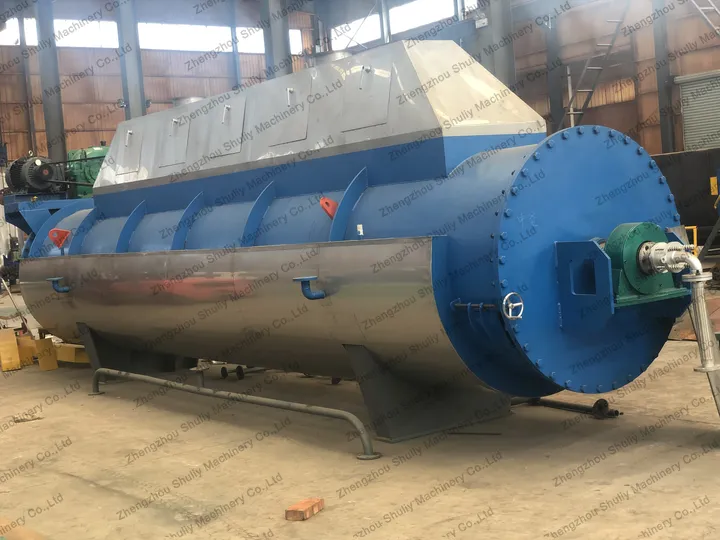
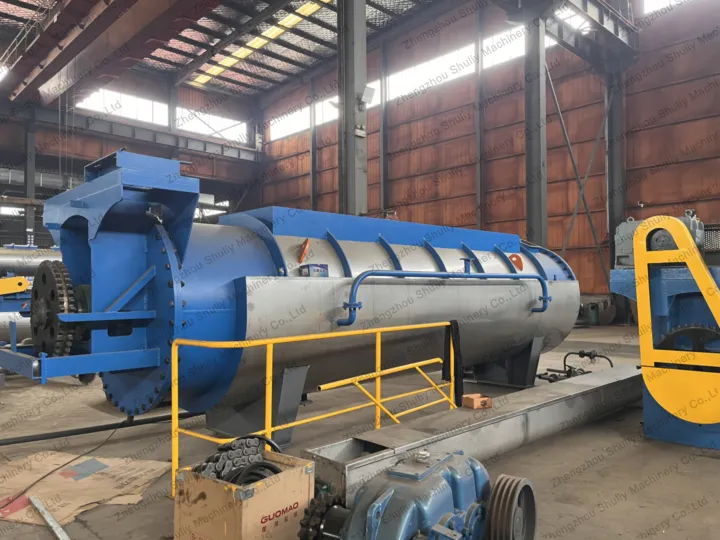
The Cozedor de peixe is a jacketed steam vessel. Steam circulates through the outer jacket and the hollow rotating shaft, transferring heat indirectly to the fish mass. Because there is no direct steam injection, protein loss from condensate is avoided. The table below lists steam consumption for our six standard cooker models.
| Cooker model | Capacidade | Steam consumption | Heating area |
|---|---|---|---|
| SL-20 | >20 t/d | 220 kg/h | ~5 m² |
| SL-30 | >30 t/d | 300 kg/h | ~7 m² |
| SL-50 | >50 t/d | 450 kg/h | ~14 m² |
| SL-80 | >80 t/d | 600 kg/h | ~16 m² |
| SL-150 | >150 t/d | 1,100 kg/h | ~28 m² |
| SL-300 | >300 t/d | 2,200 kg/h | ~55 m² |
Working pressure: 0.6 MPa. Outlet temperature: 90–95 °C. These numbers come from the cooker spec sheets used in real installations across Morocco, Indonesia, Oman, and Chile.
2. Steam Dryer — the largest steam load
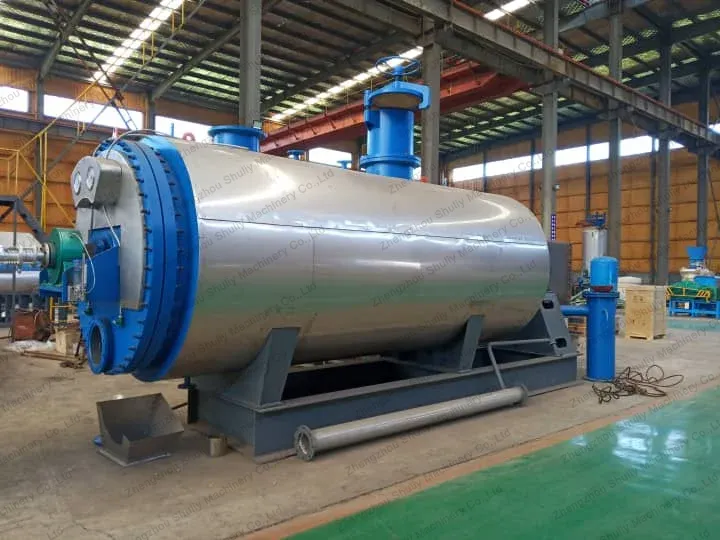
The Secador de farinha de peixe is a conductive continuous dryer. Steam flows through the rotor shaft and the heating coils, the rotating scraper continuously exposes wet meal to the hot surface, and condensate is discharged through a rotary joint at the end of the shaft.
Steam load on the dryer depends on heating area. The 250T/D plant Shuliy recently shipped runs six steam dryers in parallel: four Φ1300 × 8000 units at 100 m² heating area, plus two Φ1200 × 7000 units at 75 m². That is 550 m² of total heating surface, demanding roughly 6 tons of steam per hour when running at full load.
3. Pipeline and vessel heat tracing
Often forgotten: the piping between the fish meal plant boiler and the cooker/dryer loses heat. In a cold-climate plant, an extra 5–10% of fuel goes into keeping the steam line hot. Insulating the steam manifold is one of the cheapest energy upgrades a plant can make.
How to Size the Boiler: A Practical Method
The fish meal plant boiler capacity is rated in tons of steam per hour (t/h) or in boiler horsepower (BHP). One t/h equals roughly 600 kg of steam at 0.6 MPa coming from a 100 °C feed. Sizing is a four-step calculation.
- Sum the rated steam consumption of every steam-consuming device at full load. Add the dryer steam (typically 1.2–1.4 kg steam per kg of water evaporated) and the cooker steam from the table above.
- Apply a simultaneity factor. Not every device draws full steam at the same moment, but startup surges do happen. Shuliy engineers apply a 1.10–1.20 multiplier on top of the theoretical sum.
- Add a 20–25% margin for future capacity expansion and to keep the boiler out of continuous maximum-fire operation. Boilers that run flat-out age fast and waste fuel.
- Match the working pressure. Cookers and dryers in the Shuliy standard configuration operate at 0.6 MPa. The boiler should be rated for 1.0 MPa with a pressure-reducing station, so it never idles at the edge of its pressure range.
Sizing reference table
| Plant capacity | Cooker steam (kg/h) | Dryer steam (kg/h) | Total + margin | Recommended boiler |
|---|---|---|---|---|
| 1–5 T/D | 220 | ~300 | ~0.6 t/h | 0.5 t/h, 1.0 MPa |
| 20 T/D | 220 | ~700 | ~1.1 t/h | 1 t/h, 1.0 MPa |
| 50 T/D | 450 | ~1,200 | ~2.0 t/h | 2 t/h, 1.0 MPa |
| 80 T/D | 600 | ~1,800 | ~2.9 t/h | 3 t/h, 1.0 MPa |
| 150 T/D | 1,100 | ~3,000 | ~4.9 t/h | 5 t/h, 1.0 MPa |
| 250 T/D | 2,200 (two lines) | ~6,000 | ~9.8 t/h | 10 t/h, 1.0 MPa (or 2 × 5 t/h) |
For very large plants, Shuliy often specifies two medium boilers instead of one giant boiler. If one unit goes down for maintenance, production continues at half capacity instead of stopping completely. This is what we did on the 250T/D project — two parallel 5 t/h boilers feed the six dryers and two cookers.
Fuel Cost Comparison: Diesel vs Gas vs Coal vs Electricity
Every fuel has the same job: turn feed water into steam at 0.6 MPa. The cost difference comes from fuel price, calorific value, and boiler efficiency. The table below uses current market reference prices and standard boiler efficiency ratings.
| Fuel | Heat value | Boiler efficiency | Fuel needed per 1 t steam | Reference price (USD) | Cost per 1 t steam |
|---|---|---|---|---|---|
| Diesel | ~36 MJ/L | ~88% | ~75 L | $0.90/L | ~$68 |
| Natural gas | ~38 MJ/m³ | ~90% | ~75 m³ | $0.40/m³ | ~$30 |
| LPG | ~50 MJ/kg | ~90% | ~54 kg | $0.80/kg | ~$43 |
| Coal (bituminous) | ~24 MJ/kg | ~75% | ~125 kg | $0.20/kg | ~$25 |
| Biomass (wood pellet) | ~17 MJ/kg | ~80% | ~165 kg | $0.15/kg | ~$25 |
| Electricity | 3.6 MJ/kWh | ~98% | ~680 kWh | $0.10/kWh | ~$68 |
Translated into real plant numbers, here is the monthly fuel bill for a 50T/D fish meal plant running 20 hours per day, 25 days per month, at ~1.5 t/h steam load = 750 tons of steam per month.
- Diesel: 750 × 68=∗∗ 51,000/month**
- Natural gas: 750 × 30=∗∗ 22,500/month**
- Coal: 750 × 25=∗∗ 18,750/month**
- Biomass: 750 × 25=∗∗ 18,750/month**
- Electricity: 750 × 68=∗∗ 51,000/month**
The gap between natural gas and diesel is about $28,500 per month for a 50T/D line. Over a year, that is more than the cost of the boiler itself.
Why steam drying is cheaper than diesel-fired direct drying
Some small plants use a direct-fired diesel burner to blow hot flue gas through the dryer. It looks like a cheaper setup — no boiler, no piping. But the flue gas carries unburned hydrocarbons into the meal, the burner cannot respond to moisture changes, and thermal efficiency is typically below 60%.
Indirect steam drying keeps the combustion gases fully separate from the product. Protein stays clean, color stays light, and the boiler runs at 85–92% efficiency instead of 55–60%. In our experience, the steam-dried plant uses 25–35% less fuel per ton of finished meal than the direct-fired plant. Over 12 months, that is not a small number.
Can Fish Meal Plants Use Biomass or Waste Heat?
Yes, and an increasing number of plants do. Three realistic options.
Option 1: Biomass boiler (wood pellet, rice husk, palm shell)
Biomass boilers can cover the same 1–10 t/h capacity range as gas or oil boilers, and the fuel is often a byproduct the plant already has access to. A fish meal plant in Southeast Asia running on palm shell, or a South American plant running on sawdust, can cut its fuel bill by 40–60% versus diesel. The trade-off is fuel handling — you need storage, automatic feeding, and ash removal — and biomass boilers typically need a larger footprint.
Option 2: Waste heat recovery from the dryer exhaust
The secondary steam leaving the dryer jacket still carries 200–300 kJ/kg of latent heat. In a standard plant this is vented to atmosphere. By adding a heat exchanger on the dryer exhaust, the condensate can be pre-heated from 30 °C to 80 °C before entering the boiler. This reduces fuel consumption by 5–8% with no extra fuel cost. Shuliy’s standard dryer design already includes a condensate recovery line that returns hot water to the boiler feed tank.
Option 3: Combined heat and power (CHP)
For plants above 100T/D, a natural-gas CHP unit can supply both electricity and process steam from the same fuel input. The thermal efficiency can exceed 85%, and the electricity offsets a portion of the plant’s grid bill. CHP is a capital-intensive option, but for a 250T/D plant running 24/7, payback is typically 2–3 years.
Shuliy’s Energy-Saving Design Features
Shuliy builds the steam system into the line, not onto it. Three design choices in the standard equipment package directly reduce fuel consumption.
- Indirect steam cooking. Steam never touches the fish mass. This avoids the condensate dilution that direct steam injection causes, and the same steam that heats the cooker jacket gives up its latent heat inside the dryer coils downstream.
- Condensate return system. Every cooker and dryer is fitted with an automatic condensate return. Hot condensate (typically 90 °C) goes back to the boiler feed tank instead of being drained. The boiler therefore does not have to heat cold makeup water from 20 °C — it heats it from 85–90 °C. This saves 8–12% of the fuel bill on its own.
- Low-temperature quick-dry technology. The dryer operates at 130–150 °C jacket temperature rather than 180–200 °C. Lower temperature means lower stack losses, and the protein is protected — true protein loss stays below 5% in our standard configuration.
Combined, these features reduce the steam required per ton of finished meal by 20–30% compared with older plant designs. For a 50T/D line, that is a recurring annual saving of 40,000–90,000 depending on fuel choice.
Real Energy Bills: Three Plant Sizes
The numbers below come from operating Shuliy lines, with fuel prices normalized to mid-2025 levels. Treat them as a starting point, not an estimate — your local fuel price and operating hours change everything.
Case A: 20T/D plant in West Africa (diesel boiler)
- Steam load: ~1.0 t/h × 18 h/d = 18 t/d
- Diesel at $0.95/L, ~75 L per ton steam
- Daily fuel: 18 × 75 × 0.95=∗∗ 1,283/day**
- Monthly (25 days): ~$32,000
- Annual: ~$385,000
Case B: 50T/D plant in Southeast Asia (coal boiler)
- Steam load: ~1.5 t/h × 20 h/d = 30 t/d
- Coal at $0.18/kg, ~125 kg per ton steam
- Daily fuel: 30 × 125 × 0.18=∗∗ 675/day**
- Monthly (25 days): ~$16,875
- Annual: ~$202,000
Case C: 250T/D plant in South America (natural gas boiler + CHP)
- Steam load: ~8 t/h × 22 h/d = 176 t/d
- Natural gas at $0.35/m³, ~75 m³ per ton steam
- Daily fuel: 176 × 75 × 0.35=∗∗ 4,620/day**
- Monthly (28 days): ~$129,000
- Annual (with CHP electricity offset ~30%): ~$1.08M net
The pattern is clear: the larger the plant, the more leverage you have on fuel choice. A 20T/D line in a remote location may have no option but diesel. A 250T/D plant in a port city can usually negotiate a gas pipeline or build a CHP. Always evaluate the fuel market before signing the boiler purchase order.
Plan Your Boiler and Energy System with Shuliy
Boiler selection is the line item most buyers under-budget and most operators later wish they had over-budgeted. Shuliy’s engineering team prepares a complete utility package with every linha de produção de farinha de peixe quotation: steam load calculation, recommended boiler size, fuel comparison for your local market, and condensate return design.
Send us your planned capacity, your available fuel, and your electricity price. We will return a sized boiler specification, an estimated monthly fuel cost, and a layout showing how the boiler room connects to the cooker, the dryer, and the condensate return system.
Shuliy Machinery has built fish meal plants from 1T/D to 500T/D in more than 50 countries. Every line ships with a sized boiler specification, an energy budget, and a full engineering package for installation and commissioning.