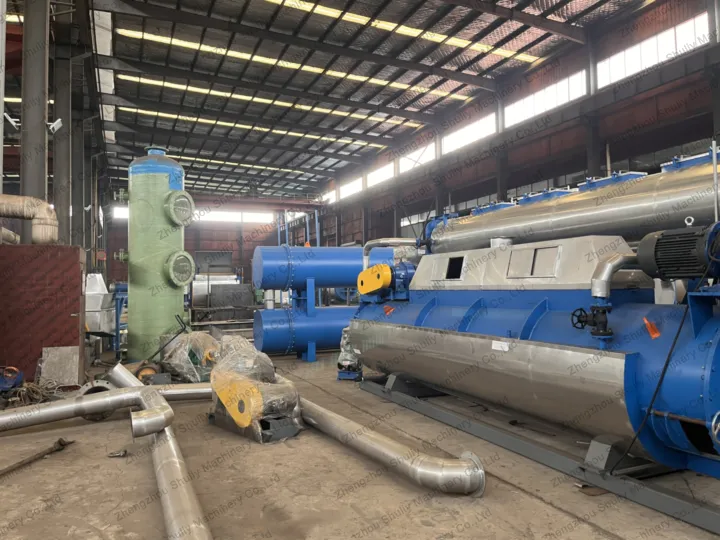














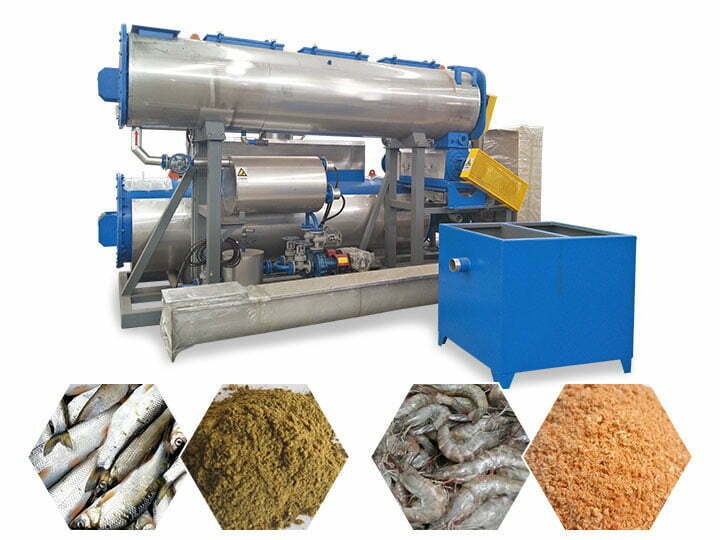
Shuliy planta de harina de pescado a bordo is a compact, fully integrated fishmeal production unit designed for 1–5 tons of finished fish meal per day. Unlike a full fish meal production line — which is a series of standalone machines — this unit combines cooking, pressing, drying, and oil separation in a single welded frame. It fits inside a ship’s engine room or a small workshop, and it produces the highest-grade meal because the fish are processed within hours of being caught.
For more than a decade, Shuliy has shipped these onboard plants to fishing fleets in Somalia, Chile, Indonesia, Morocco, Oman, and the United States. This page covers what the unit contains, how it works, the technical specifications, and the operating data buyers typically want before signing a purchase order.
What Is an Onboard Fish Meal Plant?
An onboard fish meal plant is a self-contained fishmeal processing system that combines every step of the fish meal production line — cooking, pressing, drying, and oil separation — into a single compact frame. The compact design has three practical advantages over a full modular line:
- Small footprint — the unit occupies roughly 12–18 m², allowing it to be installed inside a fishing vessel’s engine room or a small workshop.
- Lower equipment cost — typically 35–50% less than a full modular line of the same daily output.
- Freshest possible raw material — when installed on a fishing vessel, fish are processed within 2–4 hours of catch, producing the lightest-colored, highest-protein fish meal (65–70% crude protein).
The Shuliy compact fish meal plant is the right choice for daily outputs of 1–5 tons of finished meal. For outputs above 5T/D, we recommend our modular línea de producción de harina de pescado, which allows independent capacity expansion of each processing step.
Technical Specifications of Compact Fish Meal Plant
| Modelo | 250 kg/h Integrated Fish Meal Machine | 500 kg/h Integrated Fish Meal Machine |
| Raw material processing | 250 kg/h | 500 kg/h |
| Yield | 50–60 kg/h of fish meal and 12.5–15 kg/h of fish oil | 100–125 kg/h of fish meal and 25-40 kg/h of fish oil |
| Fish meal yield | 20%–25% | 20%–25% |
| Finished fish meal specifications | Moisture ≤10% Fat ≤10% | Moisture ≤10% Fat ≤10% |
| Fish oil yield | 5%–8% | 5%–8% |
Note: There are two heating methods for this onboard fish meal plant, respectively:
- Electric heating – Thermal oil heater
- Steam heating – Boiler configuration
Both models are CE-marked, ship in a single 40HQ container, and are delivered with a complete installation manual, P&ID drawing, and PLC ladder program.
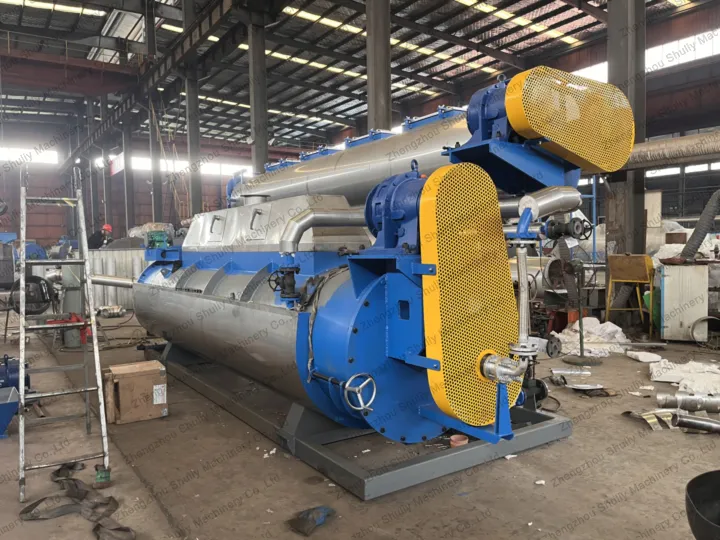
Advantages of 1-5T/D Onboard Fish Meal Plant Machine
- Lower capital investment
- The integrated design costs roughly 35–45% less than an equivalent-capacity modular line, making it the most common entry point for small operators and fishing cooperatives.
- Compact footprint
- The cooking, pressing, and drying sections are vertically stacked on a single welded frame. A 5T/D unit fits inside a 24 m² cabin.
- Stable operation on a moving ship
- Shuliy’s onboard fish meal unit is designed for vessel motion. The plant runs continuously in sea state 4 conditions without measurable vibration, even with a 30 cm hull roll.
- Freshest raw material, lightest meal color
- Whole fish processed within 2–4 hours of catch retains a pale, golden color. The meal sells at the top of the feed-grade price band — typically 8–15% above meal made from chilled or frozen fish. For buyers targeting aquaculture or pet-food markets, this color premium alone can shorten the plant’s payback period by 2–3 months.
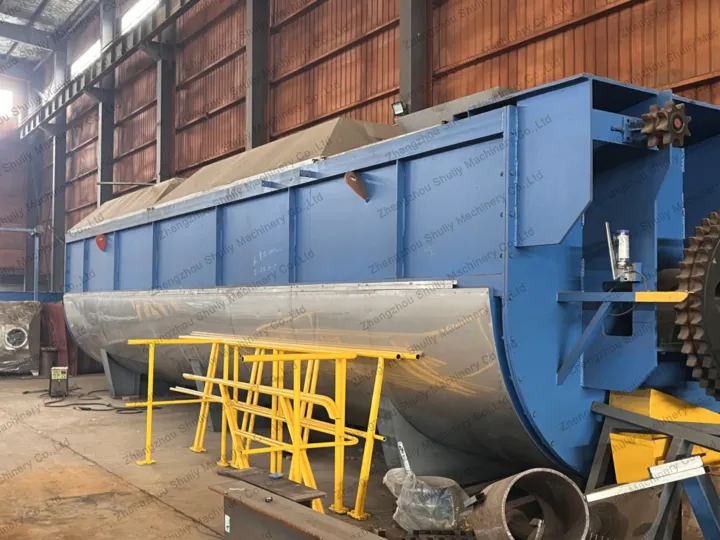
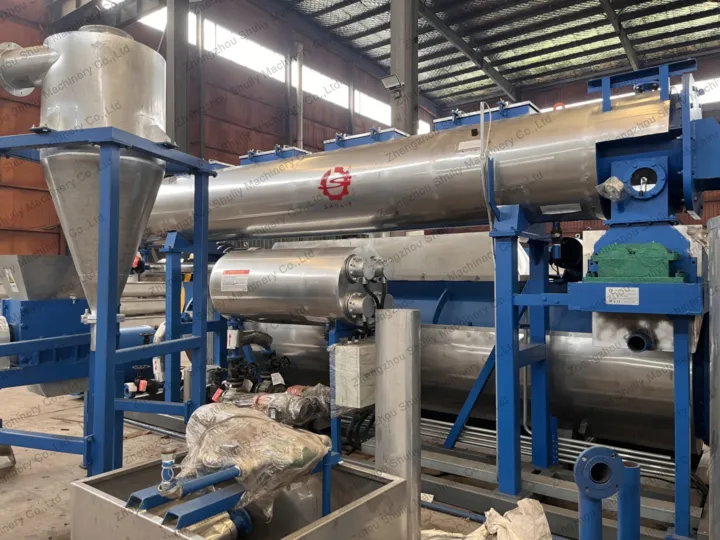
Working Principle: How Fish Becomes Fish Meal in One Unit
The Shuliy onboard fish meal plant uses a continuous four-step process. Raw fish enters at the top, finished meal exits at the bottom — and the operator only needs to monitor steam pressure and outlet temperature.
- Cook — small fish are fed by screw conveyor into the jacketed fish cooking machine, where steam at 0.6 MPa heats the mass to 90–95 °C. Protein coagulates and bound water is released.
- Prensa — the cooked mass drops into the twin-screw screw press, which squeezes out water, oil, and soluble protein. The pressed cake retains about 50% moisture.
- Dry — the cake enters the rotating fish meal dryer drum, heated internally by steam coils. The drum slowly rotates, exposing the meal to the hot surface until moisture drops below 10%.
- Separate — the liquid from the press is routed to the horizontal centrifuge where fish oil is separated from water and recovered as a sellable co-product.
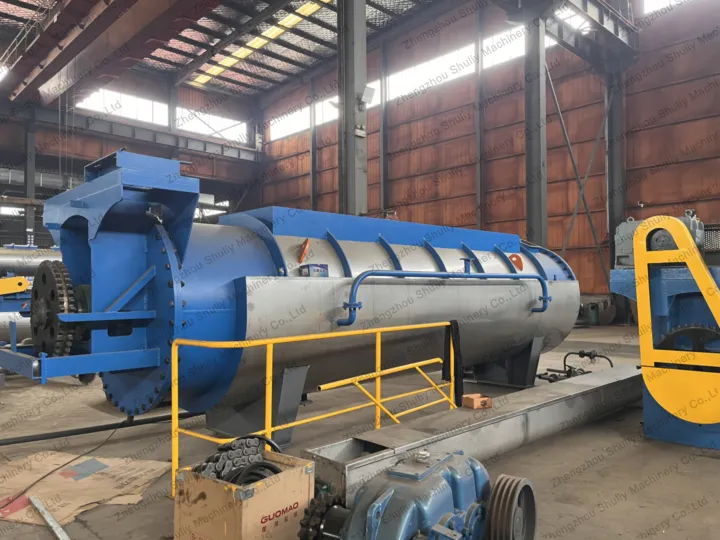
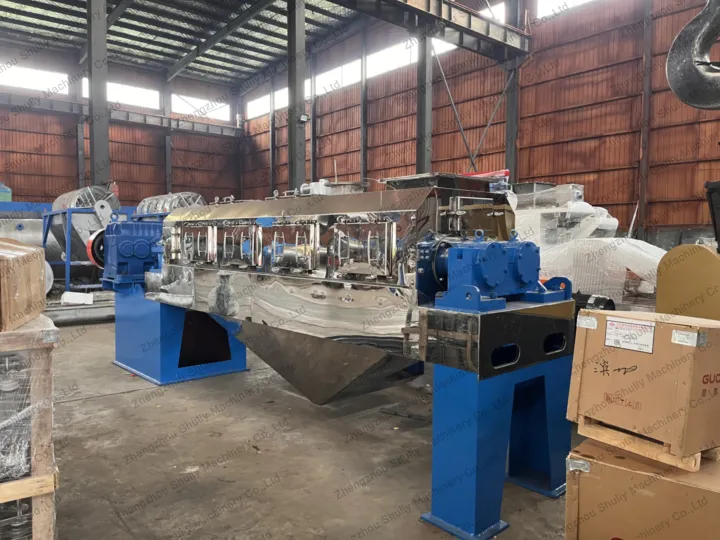
Main Components Inside the Onboard Fish Meal Unit
Although the Shuliy compact fishmeal plant is sold as a single integrated unit, the internal configuration is built from five modular process sections. Each section uses the same components Shuliy ships in our full fish meal production line — just sized for smaller throughput and mounted on a common frame.
| Section | Component | Material | Function |
|---|---|---|---|
| Feeding | U-type screw conveyor | SUS304 shell (2.5 mm) + 3 mm screw shaft | Transport raw fish to cooker |
| Cocción | Jacketed cooking machine (Φ710 × 14 mm cylinder) | Q235B carbon steel jacket | Indirect steam cooking at 0.6 MPa |
| Prensado | Twin-screw press | 16MnR blades (14 mm) + SUS304 casing | Mechanical dewatering and oil expression |
| Secado | Steam dryer (coil type, Φ76 × 5 mm) | Q235B with 60 mm insulation + SUS304 skin | Reduce moisture to below 10% |
| Separation | Horizontal centrifuge (optional) | SUS304 contact parts | Recover fish oil from press liquid |
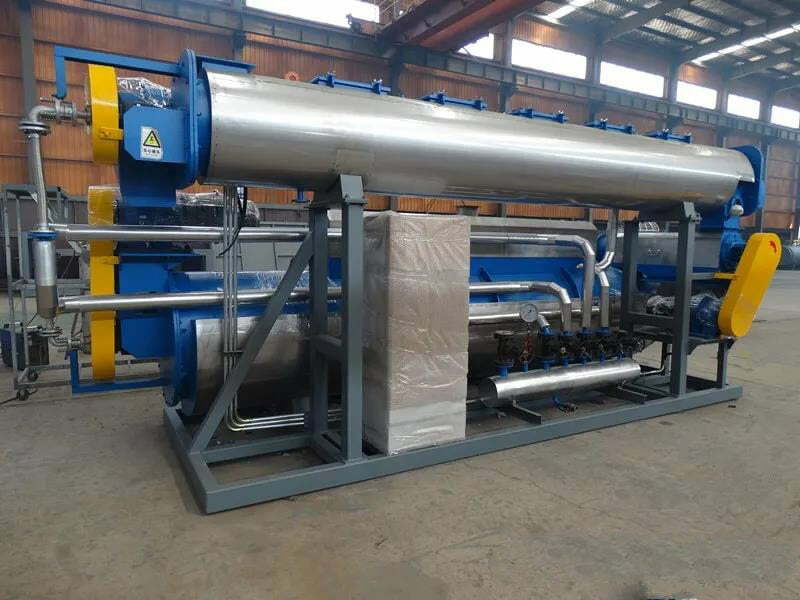
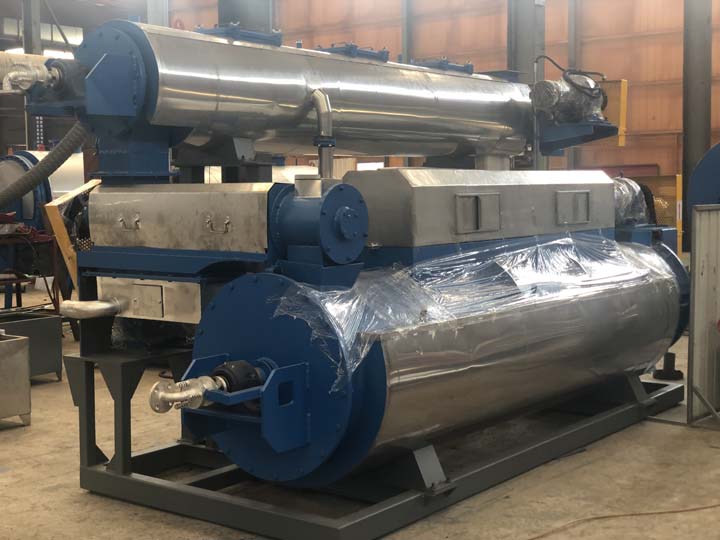
Optional add-on sections include:
- Fish cutting machine
- Fish oil separator
- Fish meal screening machine
- Spray tower deodorizing system
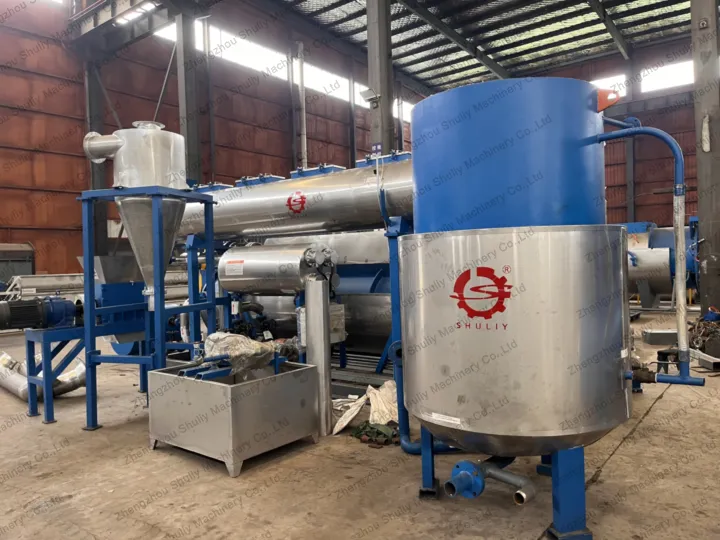
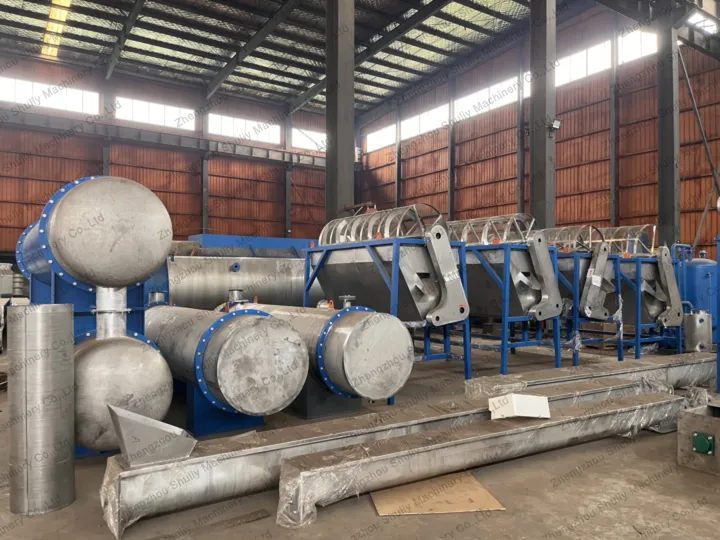
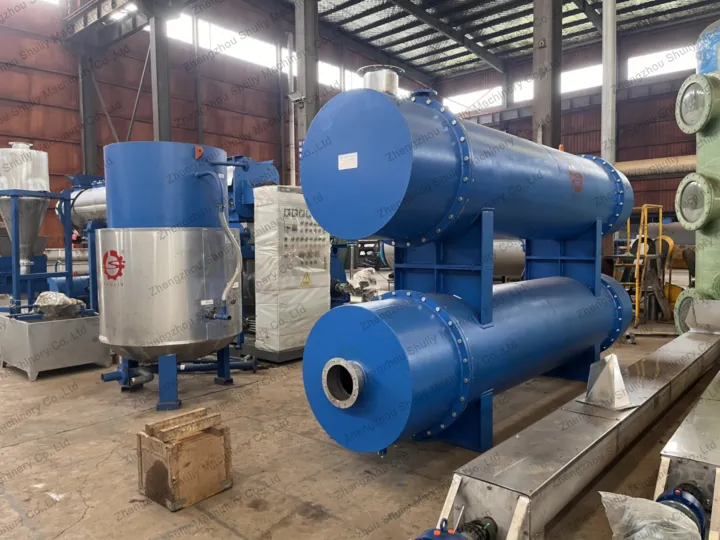
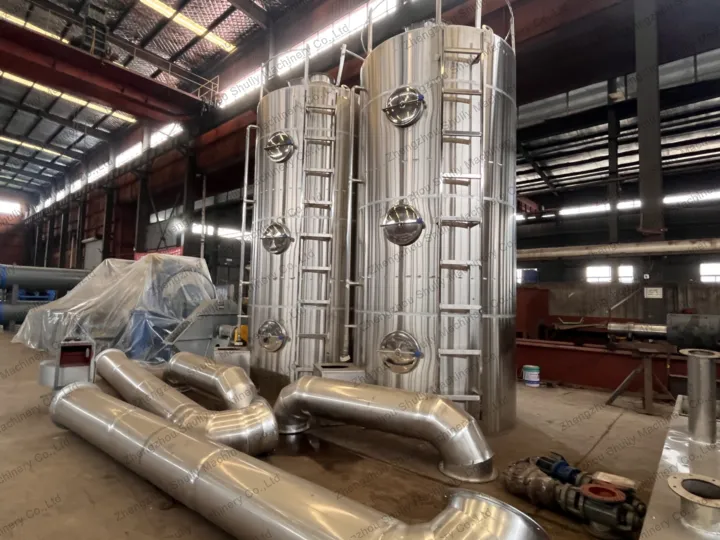
Working Process: Step by Step of Compact Fish Meal Plant
Step 1 — Feed raw material
Small whole fish are conveyed by a U-type screw conveyor directly into the máquina de cocción. For larger fish (over 30 cm) or other animal byproducts, a trituradora de pescado pre-cuts the material into 3–10 cm pieces before the cooker. The screw conveyor shell is SUS304 stainless steel (2.5 mm thick) and the inner shaft is 3 mm SUS304, so it tolerates whole fish and rough handling without corrosion.
Step 2 — Steam cook at 0.6 MPa
An external boiler supplies 0.6 MPa saturated steam to the cooker jacket. Indirect steam heating keeps the combustion gases fully separate from the product, preserving protein quality. The cooker cylinder is built from Φ710 × 14 mm seamless steel pipe with a Q235B carbon steel jacket. Rotary joints, pressure gauges, and thermometers are mounted on the cooker for continuous monitoring. Cooked material exits at 90–95 °C.
Step 3 — Press and dewater
The cooked mass drops into a twin-screw press machine. The counter-rotating 16MnR screw blades (14 mm thick) compress the material against a conical discharge end, squeezing out 50–60% of the original moisture and 70–80% of the free oil. The pressed cake exits at 45–55% moisture. The press liquid is collected in a buffer tank and either routed to the optional oil separator or returned to the cooker as condensate.
Step 4 — Steam dry the cake
The wet cake enters the rotary drum of the secador de harina de pescado. The drum rotates slowly, and Φ76 × 5 mm seamless steel steam coils heat the inner shell to 130–150 °C. Scrapers continuously turn the cake to expose fresh surface area. A 60 mm aluminum silicate insulation layer, clad in 1.0 mm SUS304, holds heat loss below 3%. Moisture at the discharge is below 10%, the standard for feed-grade fish meal.
Step 5 — Screen and crush (optional)
For producers targeting pet-food or aquaculture-grade meal, the máquina de tamizado de harina de pescado removes oversize particles, and the Trituradora de harina de pescado mills them to a uniform fine powder. Both machines can connect to a dust collector to keep the working area clean.
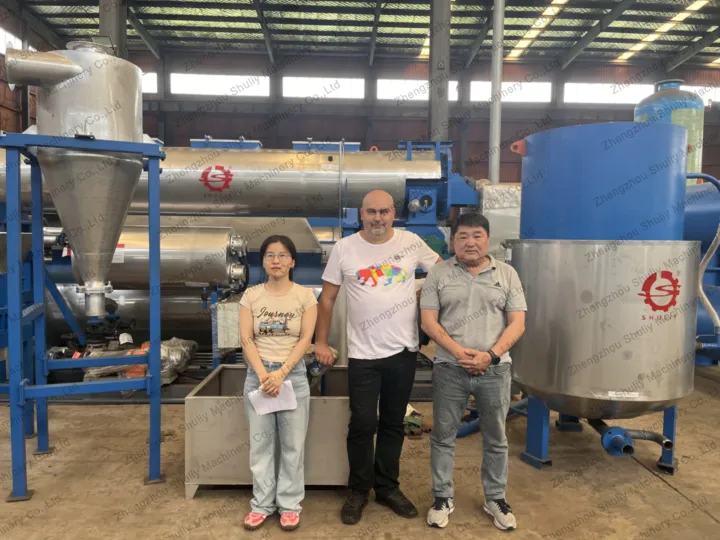
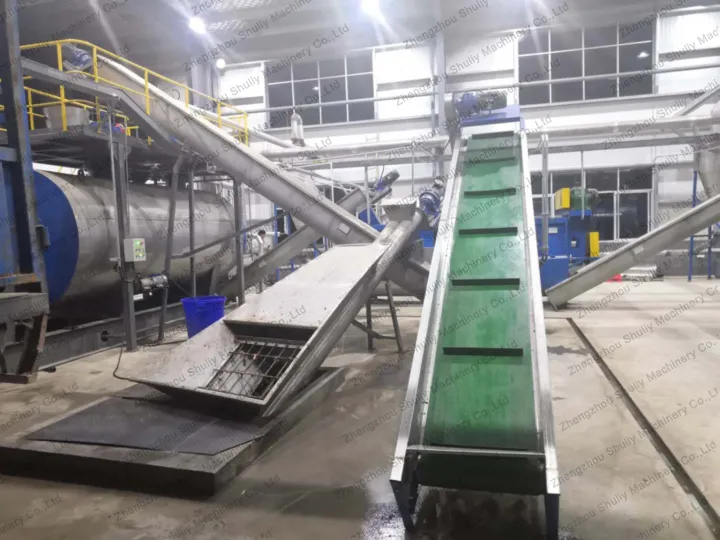
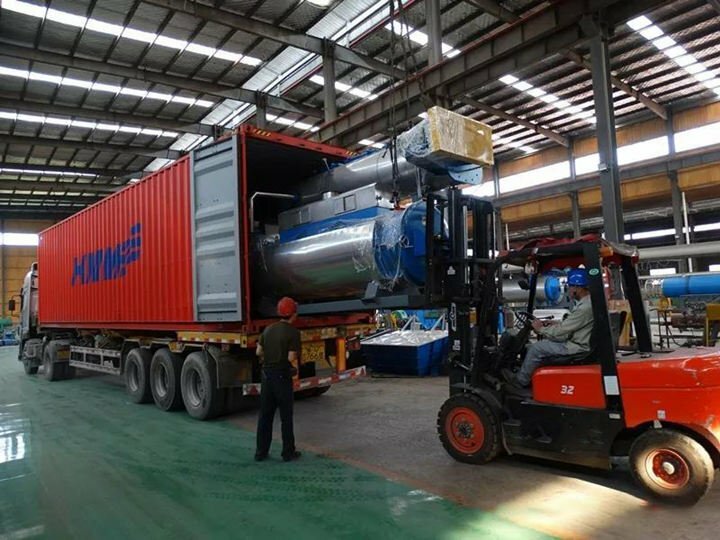
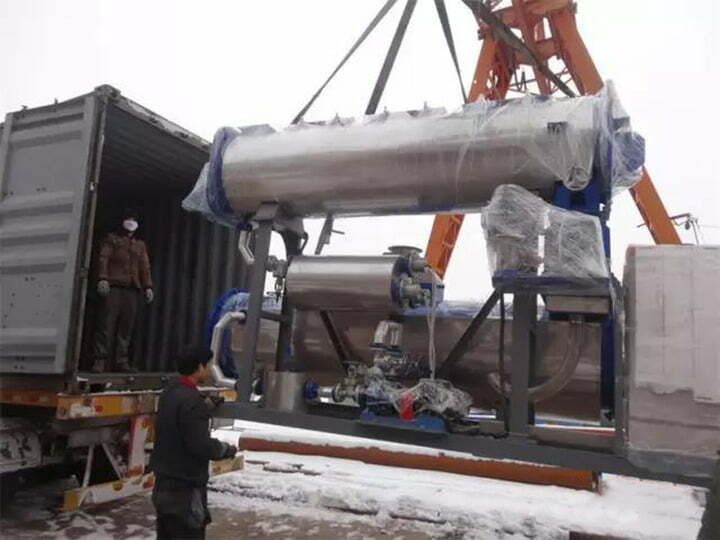
Installed Examples of 250kg/h or 500kg/h Onboard Fish Meal Plant
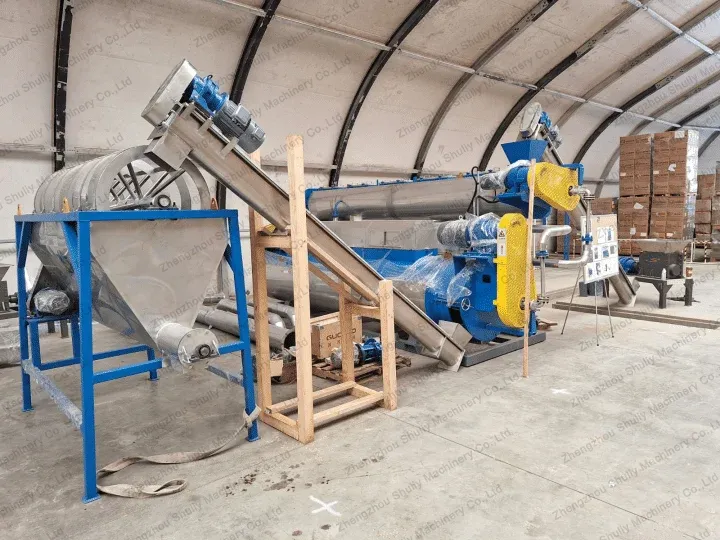
Indonesia’s 50-ton-per-day fishmeal production line successfully put into operation
Get a Quote for Your Onboard Fish Meal Plant
Shuliy has shipped more than 200 onboard fish meal plants to fishing fleets and small workshops in 50+ countries. Every quotation is built around your daily output, raw material, available space, and shipping destination. To receive a sized plant specification with itemized pricing, send us the following:
- Daily output target (1 T/D, 2 T/D, or 5 T/D)
- Raw material type (whole small fish, fish trimmings, mixed bycatch)
- Installation site (workshop floor area, or vessel cabin dimensions)
- Available steam source (we can supply the boiler if needed)
- Local grid voltage and frequency
- Shipping port for CIF quotation
For buyers who already run a full fish meal production line and want to add a small onboard unit for shipboard or pilot-scale use, our engineering team can adapt the configuration to match your existing equipment.